


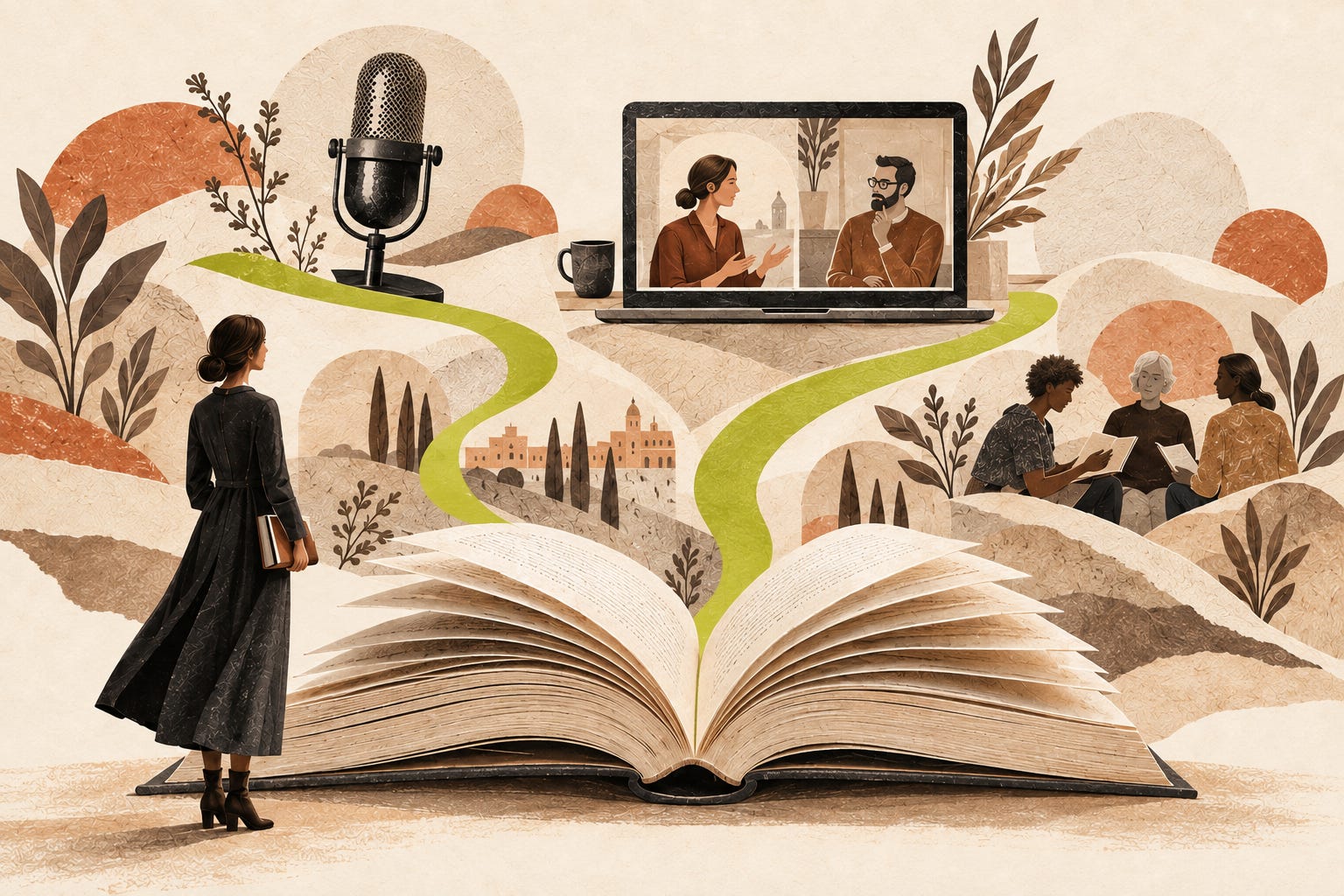
There’s something romantic about the idea of the book tour: visiting different cities, giving talks and readings, answering questions, meeting the people who read your work (and, perhaps more excitingly, the people who are now going to start reading it). It’s almost a rite of passage for many career authors, and is one of the best ways to both connect with and grow your readership.
However, it can also be logistically complex, financially burdensome, and highly time- and energy-intensive. For early career authors especially, the investment is not always clearly worth the return. There’s something paradoxical at work here: touring is important for building your audience, but it typically works best if you already have an existing one.
Fortunately, today’s authors have the opportunity to reap many of these benefits without needing to burn money on gas–or even leave the office at all, if they so choose. Virtual book tours can be an excellent way for emerging authors to kickstart their careers and for established authors to share their work with a broad, diverse audience.
The Digital Coffee Shop
Libraries, coffee shops, and indie bookstores are not the only places where today’s readers gather. Online spaces have become increasingly central to how readers both discover and engage with the work they love, and entering these spaces is one of the most powerful ways for today’s writers to reach their audiences.
Content creators on platforms like YouTube and Substack are some of the most influential voices in today’s literary scene. Collaborating with these creators can be truly transformative, and, in many cases, is directly supported by the platforms themselves.
For example, Substack allows for cross posting and guest posting, allowing creators on the platform to leverage each others’ audience for mutual growth. If you are not on Substack (which you should be, but that’s a different post altogether), you can still participate in Q&As or interviews with Substack creators, as well as getting them to review your work. Substack’s subscription-based format means that audiences tend to be highly engaged, ensuring that you are getting your work in front of readers who already trust the publication. It’s a level of advocacy that’s hard to come by anywhere else.
YouTube is another particularly powerful platform for authors. Landing an interview with a prominent creator or getting your book reviewed on a relevant channel can provide an excellent boost in exposure, with reusable video content to boot. TV interviews are still powerful, but in today’s media landscape, YouTube channels are often the ones that people tune into first.
The Role of Podcasts
One of the limitations of the traditional book tour is that it tends to center on spaces where the people we think of as “readers” usually congregate. However, there are far more readers out there than just the people with library cards or silk-screened tote bags. Let’s say you’ve written a memoir about your entrepreneurial journey or a groundbreaking guide to making flower arrangements: you might not be able to arrange a reading in a corporate office or a garden center, but you can still enter those spaces through the power of podcasts.
There are plenty of podcasts out there that are devoted to interviewing authors specifically, but there are orders of magnitude more shows that explore special-interest topics and are more than happy to interview authors who write about those topics. Familiarizing yourself with these kinds of shows can be a profoundly powerful way to reach engaged audiences who may not be passionate about reading as such, but are passionate about reading into the topics they care about. There are already podcasts out there for nearly every niche interest under the sun, and tapping into these is one of the most underrated, underutilized strategies for authors today.
Associations and Specialist Communities
Webinars and other online gatherings are another excellent way for authors to get their work in front of engaged and interested audiences. There are numerous professional, cultural, educational, and interest-based organizations that welcome author visits, both in-person and online. While we often associate webinars with an exclusively corporate audience, the format itself is highly flexible and used by organizations of all different kinds.
Like the other formats discussed above, webinars and other events hosted by associations and specialist communities allow authors to connect with the audiences that matter rather than just “readers.” This approach focuses on conversation rather than promotion, helping bring the book’s themes to life in a way that truly lasts.
Going Beyond the Bookstore
There is still plenty of value to be gained through the traditional book tour. Gone are the days, however, when that was a writer’s only option. The proliferation of online spaces dedicated to books–and to the myriad interests and experience that we write books about–provides authors of all kinds with unprecedented access to engaged audiences.
Whatever stage you are at in your writing career, going on a digital tour, whether alongside a traditional one or instead of it, can help you get your word out there and get known for your passion.